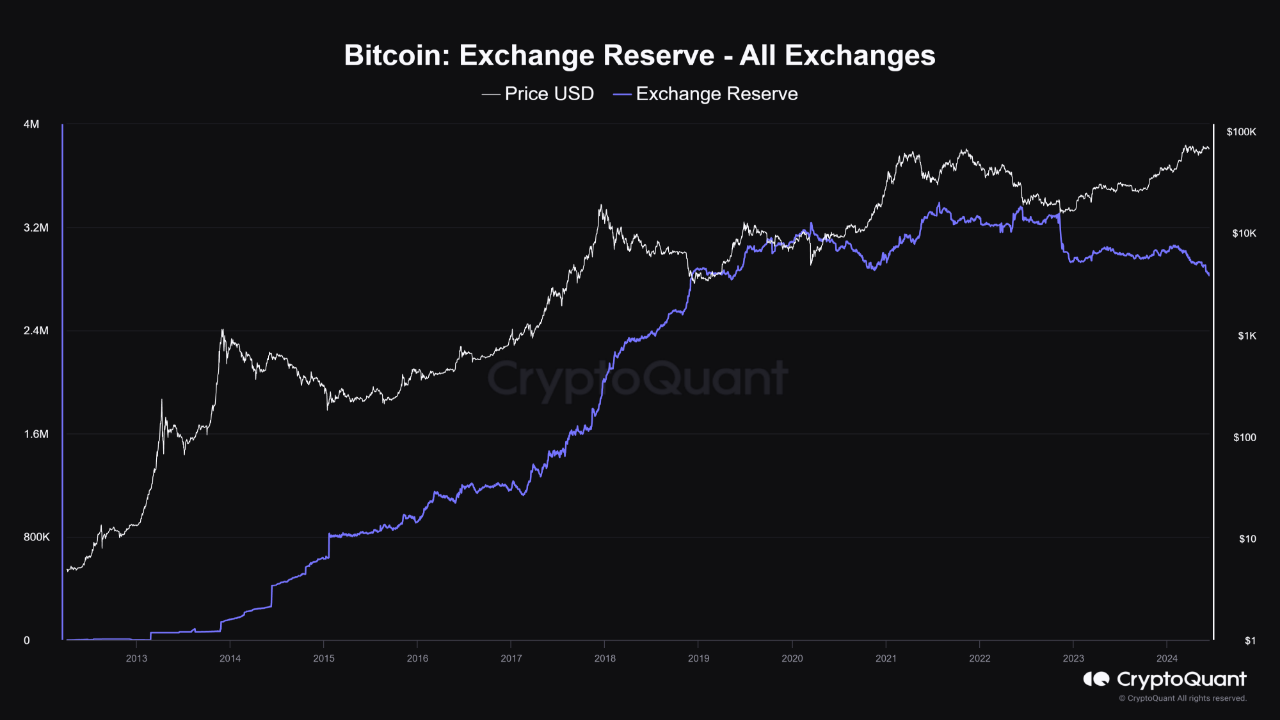
At this point, we have reached a 4 year low in the number of Bitcoin reserves on exchanges.
Funds have accumulated a total of over 1,000,000 BTC to provide Bitcoin ETFs, the best part is that this is just the beginning!
Federal Reserve rates are still just as high, it's only a matter of time before the money supply bursts into another huge bubble.
1 Bitcoin = 1 Bitcoin
∞ Money Printing = Eternal Bitcoin Growth

View original →Ethereum is currently viewed as one of the most undervalued assets in the cryptocurrency market. This perception can be attributed to several key factors:
1. Staking Involvement: Approximately 27% of all Ethereum (ETH) supply is currently staked in various protocols. Staking reduces the liquidity and available supply of Ethereum, potentially driving up its price due to scarcity.
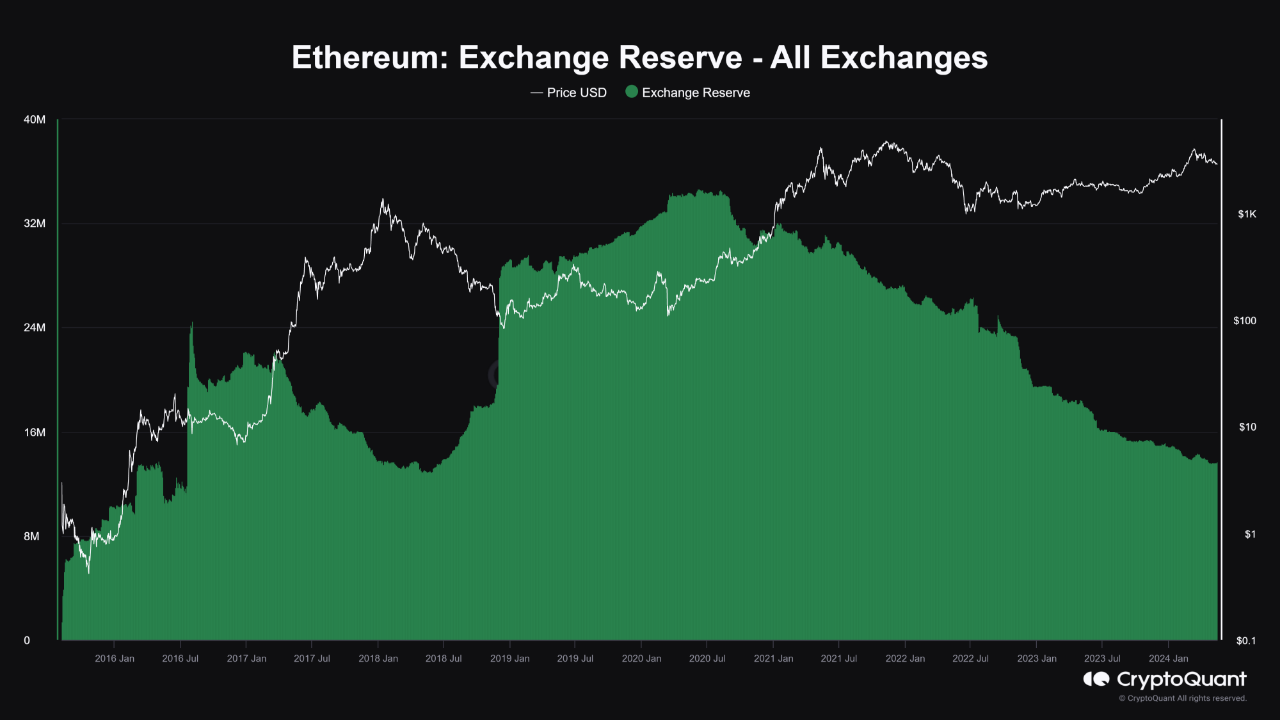
2. Low Exchange Reserves: Historical data shows a correlation between low inventory levels of Ethereum on exchanges and significant price movements:
- In July 2016, when Ethereum traded at approximately $10, exchange reserves were similar to current levels.
- Subsequent low reserve points in February 2018 ($740) and June 2018 ($450) also correlate with higher pricing relative to periods with higher reserves.
- As of May 2024, Ethereum trades at approximately $3,000 with reserves at around 13,600,000 ETH, a level historically associated with higher future valuations.
3. Supply Constraints and Demand Dynamics: The current reserve on exchanges is roughly half of what it was during the peak in November 2021, when Ethereum reached highs of $4,800 to $5,000 with 26,000,000 to 28,000,000 coins in reserves. The reduction in available supply, coupled with sustained or increasing demand, especially from the growth in DeFi applications using Ethereum as a base or collateral, supports a bullish outlook.
4. Increased Utility and Adoption: Ethereum benefits directly as the foundational platform for numerous projects, including Layer 2 solutions and cross-chain bridges, enhancing its utility and demand. The ongoing trend towards using Ethereum in DeFi, for lending, and as collateral, alongside the growth in staking and ReStaking protocols, supports its value appreciation.
5. Market Trends and Future Predictions: The potential for the adoption of spot Ethereum ETFs and increasing institutional interest could lead to higher liquidity and possibly more stable price trends.

View original →In 2021, during the peak of the bull market, approximately 2.7 million Bitcoin were held in exchange reserves, with Bitcoin trading around $69,000.
Three years later, the reserves have decreased to about 2 million Bitcoin, yet the trading prices are nearing historical highs. The recent halving event has effectively cut the potential new supply from miners by half, significantly reducing the likelihood of new Bitcoin entering the market through sales. Given these dynamics, it becomes challenging to maintain a bearish stance on Bitcoin.
Moreover, there is an observable depreciation in the value of the U.S. dollar. Anticipations are building around a potential shift in the Federal Reserve’s monetary policy, possibly reversing the direction of its quantitative easing measures and considering a rate cut, as inferred from market behaviors. The U.S. economy appears to have adapted to enduring high inflation rates.
Personally, I avoid holding U.S. dollars; at most, I convert USD to stablecoins like USDT or USDC to purchase Bitcoin.
The critical factor to focus on is supply and demand. With the current market conditions, it is increasingly difficult for individuals to accumulate even a single whole Bitcoin, which should be considered a primary investment goal.
By distancing oneself and observing market trends, time will likely reveal the strategic merits of maintaining Bitcoin holdings. HODL!!!


View original →

