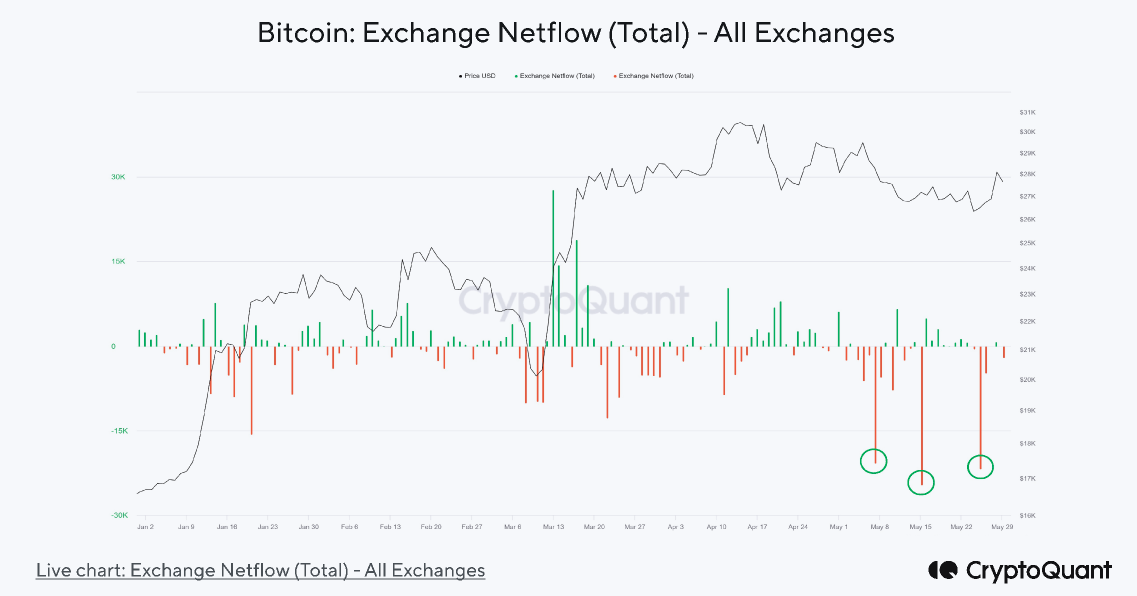
This year, Bitcoin's trading flow on exchanges has seen one of its biggest drops amidst continuing discussions about increasing the U.S. debt limit. This pattern implies that a majority of traders have a positive outlook on Bitcoin. The supply of Bitcoin on these platforms has dipped by about 28.5K Bitcoin.
Additionally, the number of Bitcoins being sent to exchanges (which could suggest a desire to sell) has been steadily reducing for the last two months. This is another indication that traders currently don't want to sell their bitcoins.
With the market mood improving, Bitcoin's price has bounced back from the average buying price of those who've held the cryptocurrency for 1 to 3 months, keeping up its rising trend over a long-term period.
On the flip side, over a short-term period, Bitcoin's price is nearly equal to the average buying price of those who've held it for less than a day. These traders are the most responsive group in the market, as they react fastest to changes in Bitcoin's price.
Over the past four days, traders have shown more confidence in cryptocurrencies by opening new futures contracts worth over $640M and $222M in the Bitcoin and Ethereum markets, respectively.
This inflow is leaning towards more purchases, as indicated by funding rates. This is why we believe the increase in price was primarily influenced by the derivatives market.
During this recent surge, we have seen the forced selling (or 'liquidation') of short positions amount to 550 Bitcoins and 4800 Ethers per hour.
To simplify further, all these points suggest that despite some economic uncertainty, traders are optimistic about Bitcoin's value, they're holding onto it, and even buying more. This increased activity and investment have helped push the price up.

View original →Bullish(Nuanced)ETH
5/24/2023 The amount of Ethereum staked has been rising rapidly, hitting record levels day by day. As of now, there are 21.93 million ETH staked.
The Shapella upgrade led to a swift reduction in Ethereum’s total supply, reinforcing its existing deflationary trend. Since this upgrade, the supply has dropped by 251K ETH. The ability to freely withdraw staked ETH provided investors with more control, encouraging them to stake more. This has led to a notable increase in the total staked value, which now represents 17.41% of Ethereum’s total supply.
The rate of Ethereum's deflation has quickened due to an increase in burnt fees, which have spiked significantly over the past year. The Ethereum network also exhibits strong activity, reflected in a high transaction count, the highest it has been in a year.
In the meantime, Bitcoin demonstrates resilience as the number of active addresses hit 1 million after a recent upswing.
Bitcoin's current value matches the average investment of holders who've been in possession for 1 to 3 months. This specific investment average has traditionally served as a solid support level, around $26.5K.
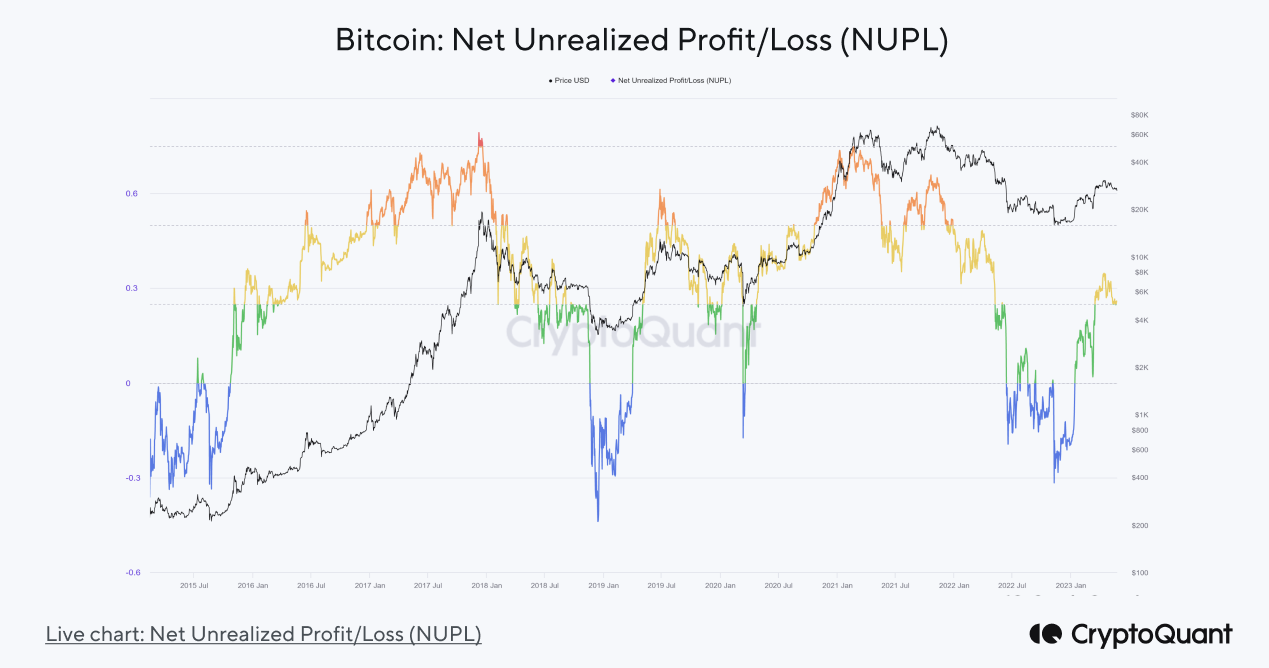
Looking at Bitcoin from a broader viewpoint, and considering the Net Unrealized Profit/Loss (NUPL), we see that investors, on average, have about 25% of profits that are yet to be realized. This is a typical scenario at the start of a Bitcoin bull market, the phase we find ourselves in now.

View original →The latest Bitcoin price dip followed Long-Term Holders (LTHs) capitalizing on the year's highest profit ratio, over 34%. Furthermore, on a broader scale, all market players managed to realize profits exceeding 7% on average.
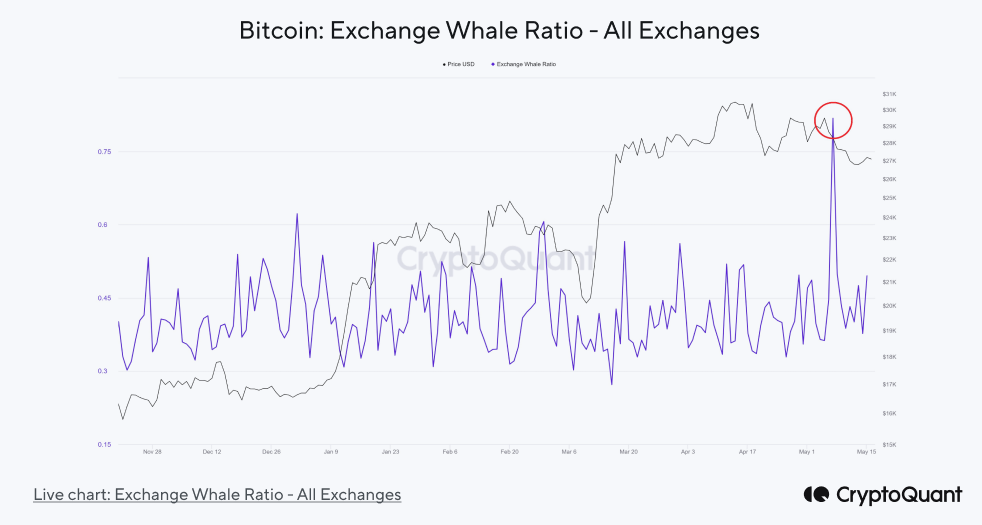
This downturn is also influenced by whales taking the lead in depositing Bitcoin into exchanges, as evidenced by the early May surge in the Exchange Whale Ratio. Without a doubt, Bitcoin transactions by these whales escalated to fairly high levels, with transfers involving more than 40% of the coins.
Simultaneously, daily miner wallet outflows reached near-record highs, contributing to the selling pressure during this adjustment period.
While miners' impact on price movements is lessening, understanding their actions remains essential given their considerable Bitcoin holdings. As it stands, miners possess more than 9% of Bitcoin's total supply, inclusive of Satoshi's coins.
Investors who have held Bitcoin for 1 to 3 months show a significant support level in their cost basis ($26.5K), indicating that this was a key point during the recent price correction.

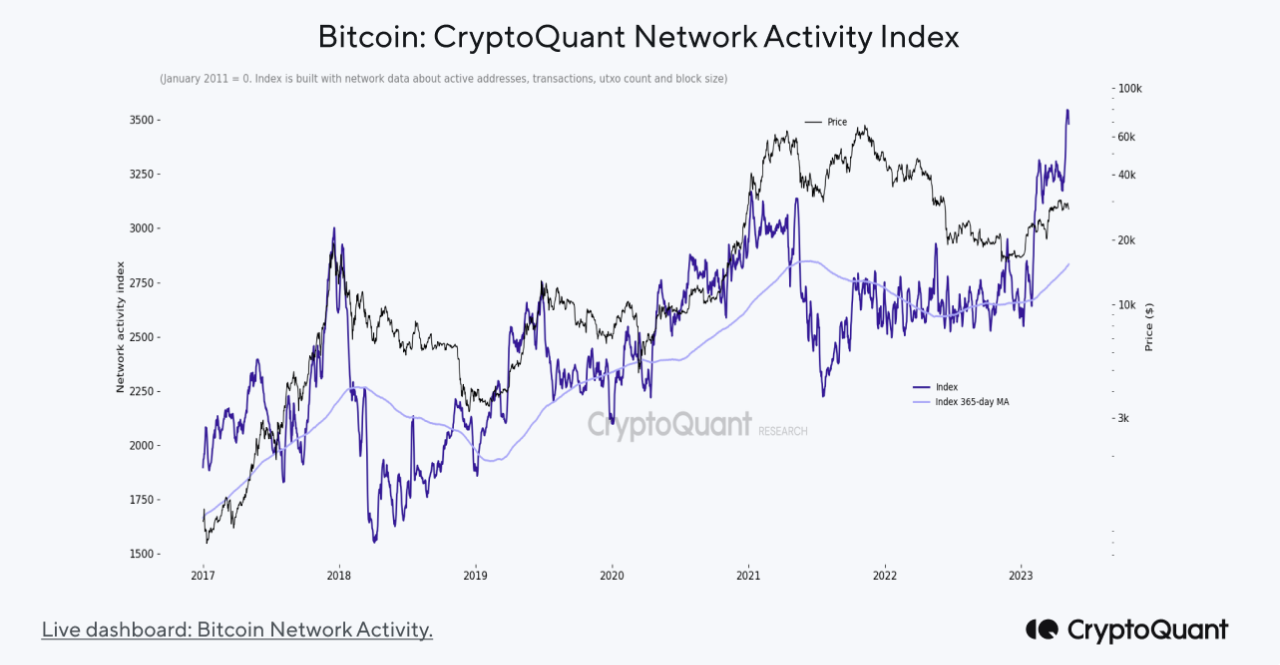
View original →Bitcoin activity has hit an unprecedented level, with daily transactions reaching a new record of 682K. This is a significant increase from 250K daily transactions at the start of 2023. The primary reason behind this surge is the growing popularity of ordinal inscriptions, which are predominantly used for creating a type of digital asset known as BRC-20 tokens.
These tokens are generated using Taproot addresses, which have seen a substantial rise since mid-April. This high usage of Taproot addresses for creating tokens further demonstrates the increasing interest in Bitcoin and its associated technologies.
Alongside this, there's a consistent increase in the number of Unspent Transaction Outputs (UTxOs). UTxOs represent the output of Bitcoin transactions that can be spent as new transactions, and an increase in their number signifies heightened activity on the Bitcoin network.
However, this surge in Bitcoin activity and the popularity of BRC-20 tokens have led to a downside: the Bitcoin network has become congested. As a result, users have been forced to pay significantly high transaction fees. The average fee per transaction has skyrocketed to $30.82, the steepest it has been since February 2021.
Moreover, these high transaction fees have started to make up a large portion of miners' earnings. Currently, daily fees constitute 42.6% of the rewards miners receive for adding new blocks to the blockchain. This is the highest percentage seen since December 2017, indicating that the current state of the Bitcoin network is impacting all its stakeholders, from everyday users to miners.

View original →From the standpoint of bitcoin holdings, on-chain data indicates that the bitcoin price has effectively hit its lowest point. Specifically, the supply of bitcoins between 18 months and 2 years usually expands as the price forms a base and then surges when the bottom is reached.
The supply of 18-month to 2-year-old bitcoins (held by holders) grows when bitcoin is undervalued (with an MVRV ratio mostly below 1 during previous market lows). As the market cycle advances, the price of bitcoin rises, making it more expensive from a valuation perspective; 18-month to 2-year bitcoin holders begin to sell their coins, causing their holdings to decrease.
In contrast, the holdings of short-term bitcoin holders (less than six months old) start to grow after prices reach their lowest point and then move upward alongside prices, which is the current situation. Short-term bitcoin holders begin accumulating coins after the lowest price point (as is the case now) and continue to do so at increasing price valuations (with a rising MVRV ratio). Therefore, a market peak will coincide with short-term holdings exceeding 6 million bitcoins. Currently, this figure is at 4.7 million.
Simultaneously, the quantity of bitcoins that haven't been moved for a year or more (1-year inactive supply) achieved a record high in late March (13.1 million) and is now at 13.0 million. The 1-year inactive supply typically grows throughout most of the bull cycle and only starts to decrease during the bull market's final stage.


View original →Bullish(Nuanced)BTC
4/26/2023 The price of Bitcoin experienced an 8% decrease last week after reaching above $30,000, which signaled the beginning of the overheated bull phase. However, the market has now exited this phase and entered into the bull stage, albeit still at high levels.
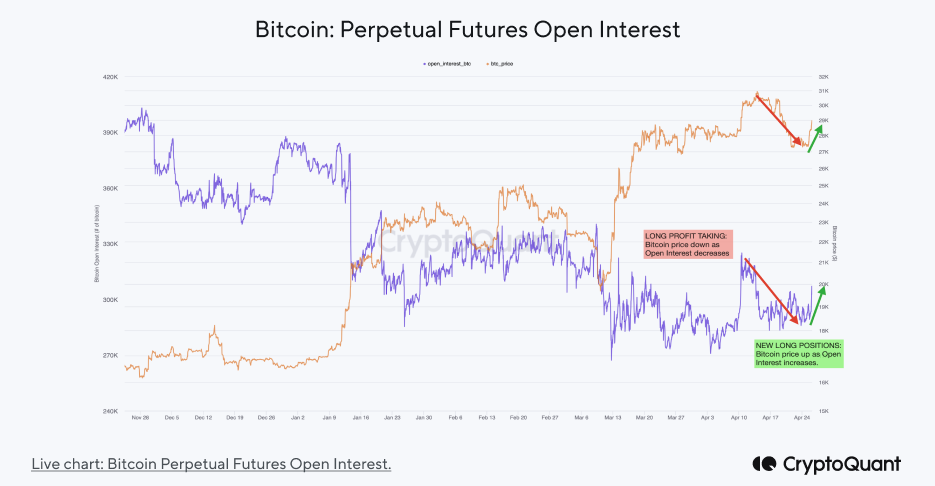
The decline in Bitcoin's price was due to profit-taking by traders in the perpetual futures markets, with open interest falling as prices fell. Nevertheless, traders are again opening long positions, and future market traders took profits following a rally in Ethereum that pushed its prices to levels above $2,000, fueled by the successful activation of the Shanghai upgrade on April 12.
Funding rates are now indicating a neutral attitude among traders, which is a shift from the bullish sentiment seen in recent weeks. Despite this, the spending activity of whales remains high, with as much as 40% of total coins being spent as prices approached the $30K zone. Typically, price rallies coincide with lower whale spending activity of around 20% of total coins being moved.
Additionally, long-term holders of Bitcoin have been spending coins at the highest profit margin since May 2022, when Bitcoin was trading at around $30,000. Conversely, short-term holders are still spending at a small profit. Typically, prices bottom out after a correction when short-term holders spend their coins at a 4% loss, as seen by the short-term holder SOPR falling to 0.96. The short-term cost basis, or the realized price, currently stands at $24,000, which is generally a good indicator of support for prices when in a bull market.

View original →Following Ethereum's Shanghai Upgrade, which took place on April 12th, there has been a noticeable surge in ETH staking inflows. The upgrade allowed for the withdrawal of staked ETH and subsequently led to an uptick in the number of deposits made for the purpose of staking ETH.
In the week following the upgrade, the volume of new depositors staking ETH reached its highest level since December 2022. Staking pools, such as Lido and Kraken, experienced significant increases in staked ETH inflows after the implementation of the Shanghai upgrade.
As of now, the average staked ETH is essentially at the break-even point, with the MVRV (Market Value to Realized Value) ratio hovering around 1, as indicated by the green line. This comes as the price of ETH (represented by the orange line) rallied approximately 10% following the successful Shanghai upgrade.
In the aftermath of the Shanghai upgrade, traders have decisively increased their long positions on ETH. The Open Interest (measured in the number of ETH) spiked to its highest level since January, even surpassing Bitcoin's Open Interest. This is illustrated in the ETH/BTC Open Interest Ratio, represented by the purple line. Consequently, the ETH/BTC price reached a one-month peak of 0.07.


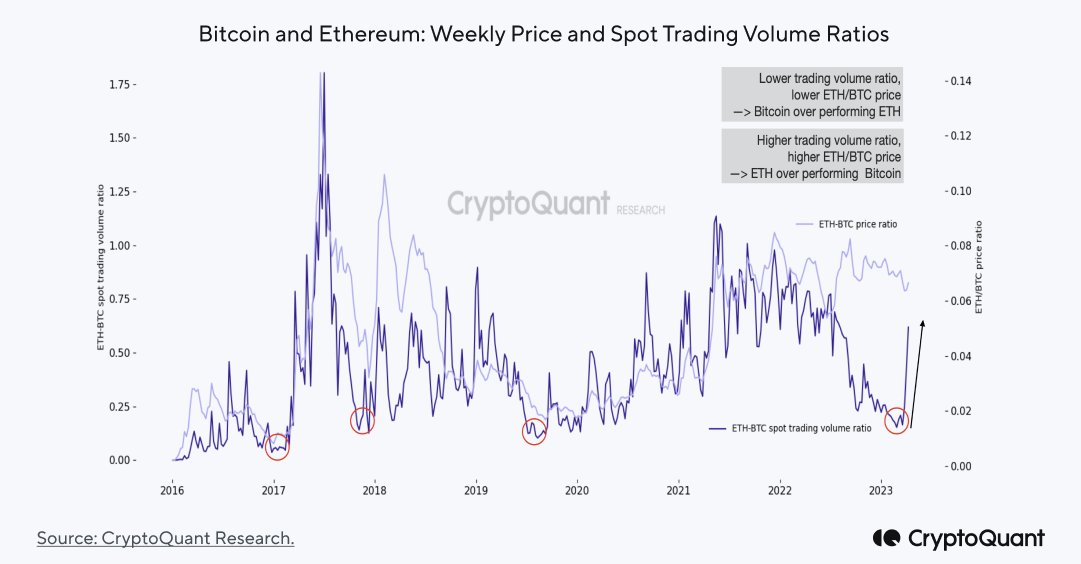
View original →Bitcoin has demonstrated a more robust performance compared to ETH, with a 14% lead in 2023. This has been evidenced by the ETH/BTC price declining to the lowest point since July 2022. Nevertheless, there is a possibility that ETH may outperform BTC in the near future for two key reasons.
Firstly, the relative spot demand for ETH has increased recently due to a decrease in BTC spot trading volume, following the suspension of zero-fee trading for most of its BTC trading pairs by Binance in March.
Secondly, futures markets are indicating a potential shift towards ETH, with the open interest and trading volume possibly bottoming out.
The uptick in ETH-BTC relative spot trading volume has been driven by the substantial decline in Bitcoin’s spot trading volume following the suspension of zero-fee trading by Binance. Additionally, there are indications that ETH will outperform BTC in futures markets. The ETH-BTC open interest ratio appears to have bottomed out before the Shanghai upgrade on April 12, indicating relatively higher demand for ETH than BTC.
Furthermore, the perpetual futures market trading volume also shows that the ETH-BTC relative volume may have reached its lowest point, which could support an increase in ETH's price in the future. However, it is important to note that ETH is still experiencing a downward trend against BTC from a valuation perspective, as the ETH/BTC MVRV ratio remains below its 365-day moving average.

View original →Bearish(Nuanced)ETH
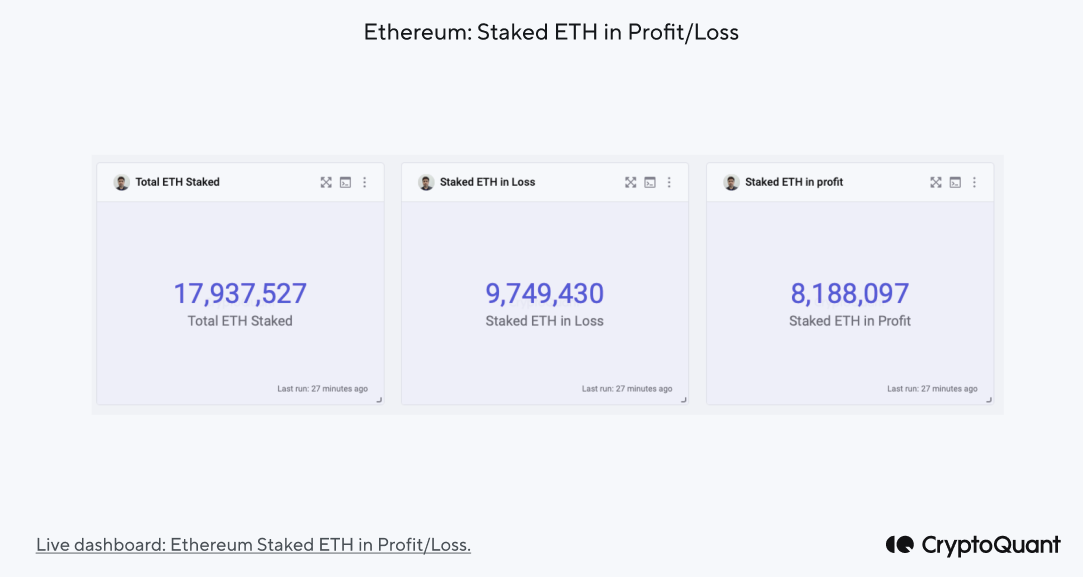
4/5/2023 The percentage of Ethereum that has been staked has been steadily increasing and has now reached more than 14% of the total Ethereum supply. There is an ongoing fear that the activation of withdrawals on April 12th with the Shanghai upgrade would bring more than usual selling pressure. However, with the current ETH prices, more than half of the staked ETH (9.7 million out of 17.9 million) is currently experiencing a loss, as the current price is lower than the price at which it was staked.
The average price at which all ETH has been staked is still higher than the current prices. The largest staking pool, Lido, which holds around 32% of all staked ETH, has an average loss of almost 20%, which has improved from 30% a month ago. It is worth noting that a significant portion of the deposits made by the Lido pool is currently underwater, which is represented by the purple area below 0 in the graph.
For the sole reason that the significant staked ETH is currently at a loss, we believe that the selling pressure will be lower than expected.

View original →Bearish(Nuanced)BTC
3/29/2023 Recently, the price of Bitcoin increased from ~$24K to ~$28K, but now the pace of the price rally has halted. In fact, it fell from a nine-month high of $28.8k to $26.9k in the last week.
This is primarily for two reasons. The first reason is that investors who bought Bitcoin recently, in other words, short-term holders, decided to sell it and take some profit or exist the position at their realized price (average cost basis).
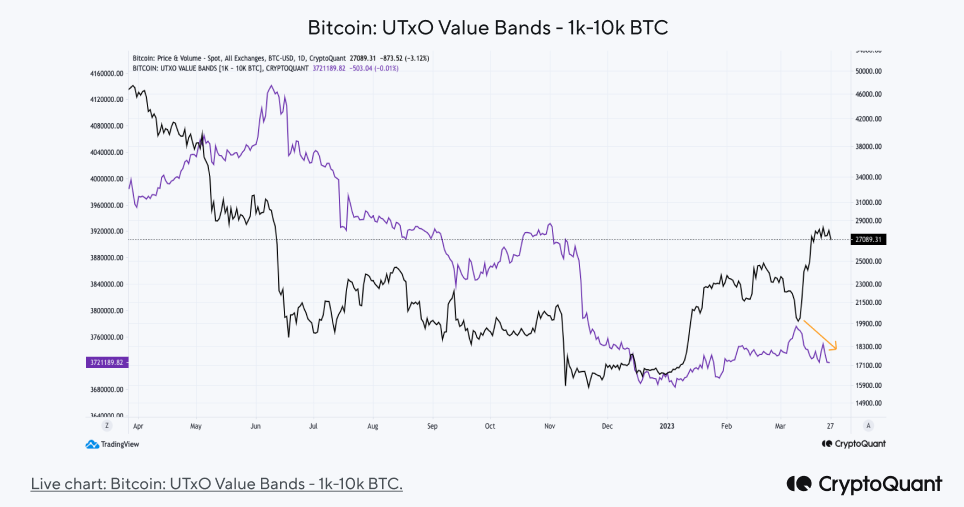
The second reason is that investors who own a large amount of Bitcoin (called "whales" holding between 1K and 10K BTC) have been spending more of their Bitcoin than usual when the price was around $28K.
As a result, their daily spending increased above 320K bitcoin, which reached 34%, a percentage of total BTC being spent, the highest since Dec ‘22. Due to this selling pressure, we are witnessing a divergence between price (increasing) and whales’ BTC holdings (falling to the lowest since early February).
And finally, 6-12-month-old coins realized price (26.8K) seems to define the mid-point of the new price range BTC has reached recently. It functions as a support and resistance level when the volatility increases.

View original →

