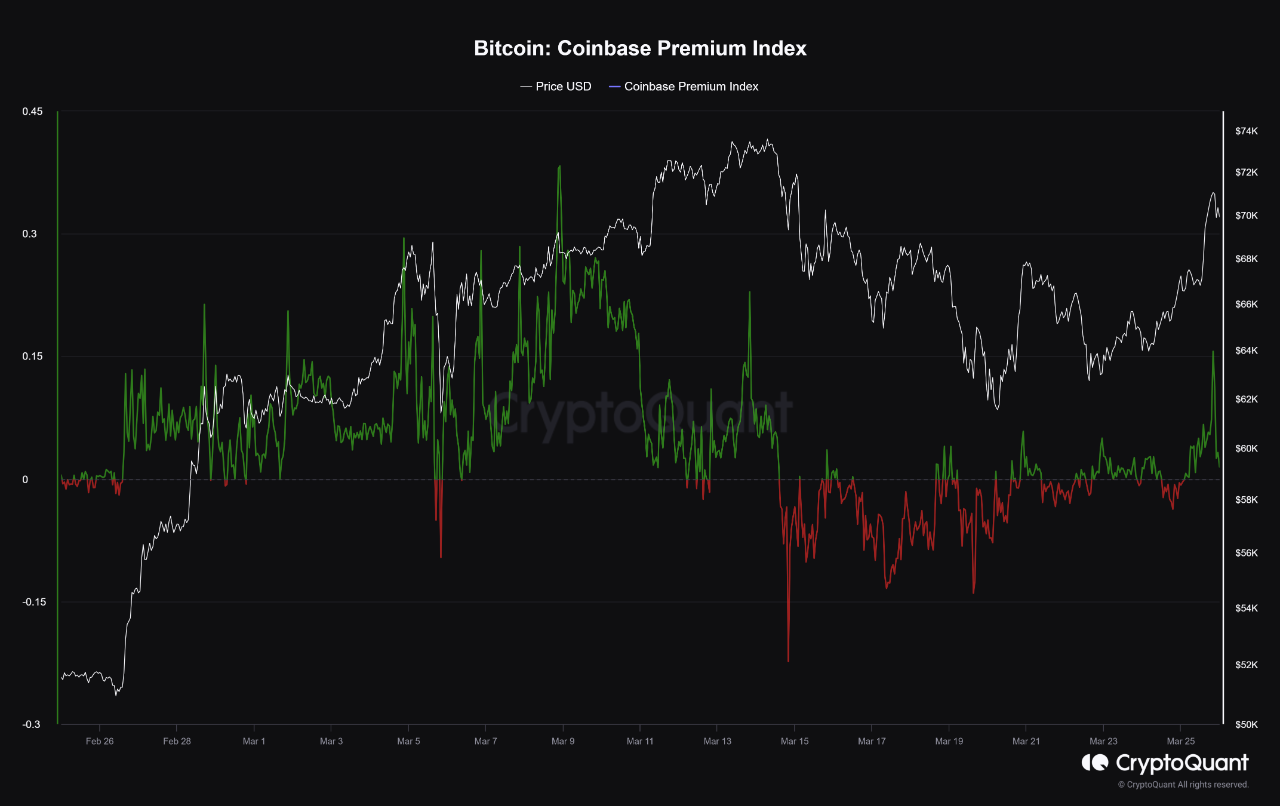
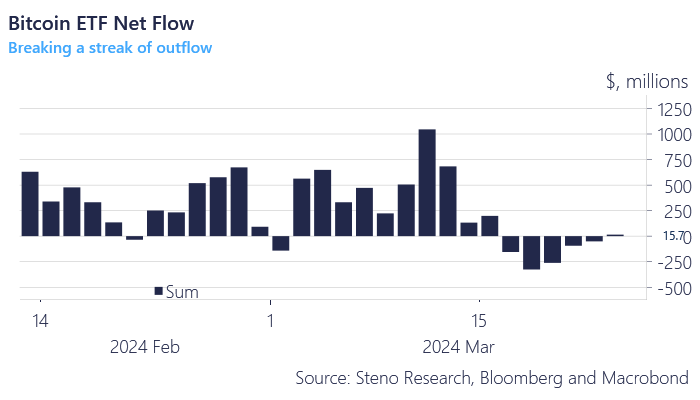
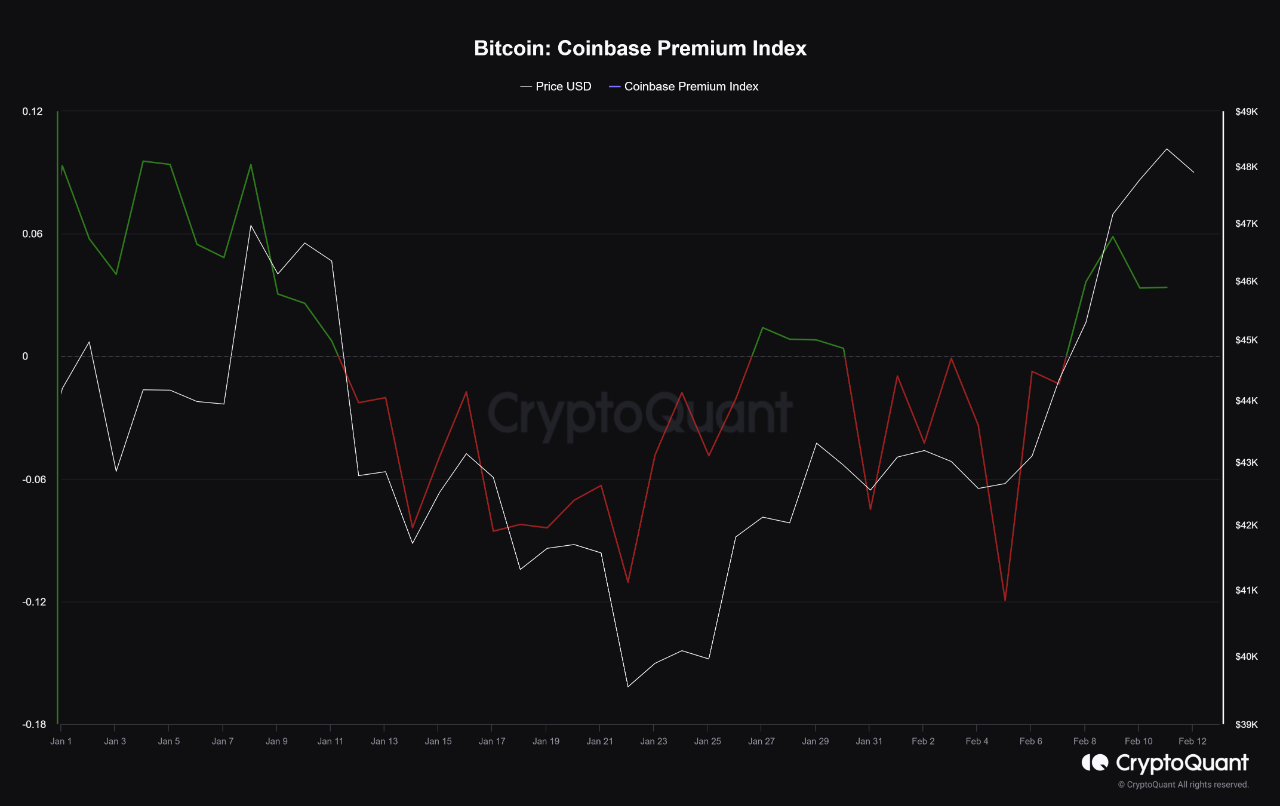
In the past few days, two vital but also interconnected factors have returned to positive territory, pointing the Bitcoin price upwards rather than down.
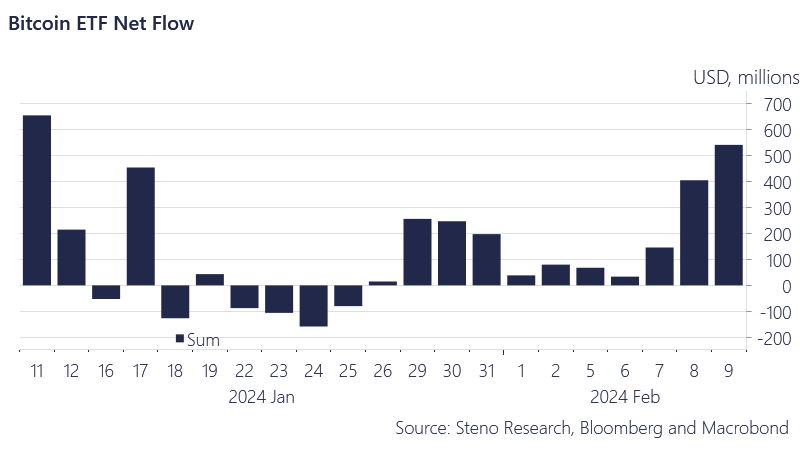
The Coinbase Premium Index is now at a premium once again, indicating that U.S. retail and institutions are buying once more. In yesterday's trading session, the Bitcoin spot ETFs broke a five-day streak of outflows by seeing a net inflow of about $15.7 million.

View original →Bearish(Nuanced)BTC
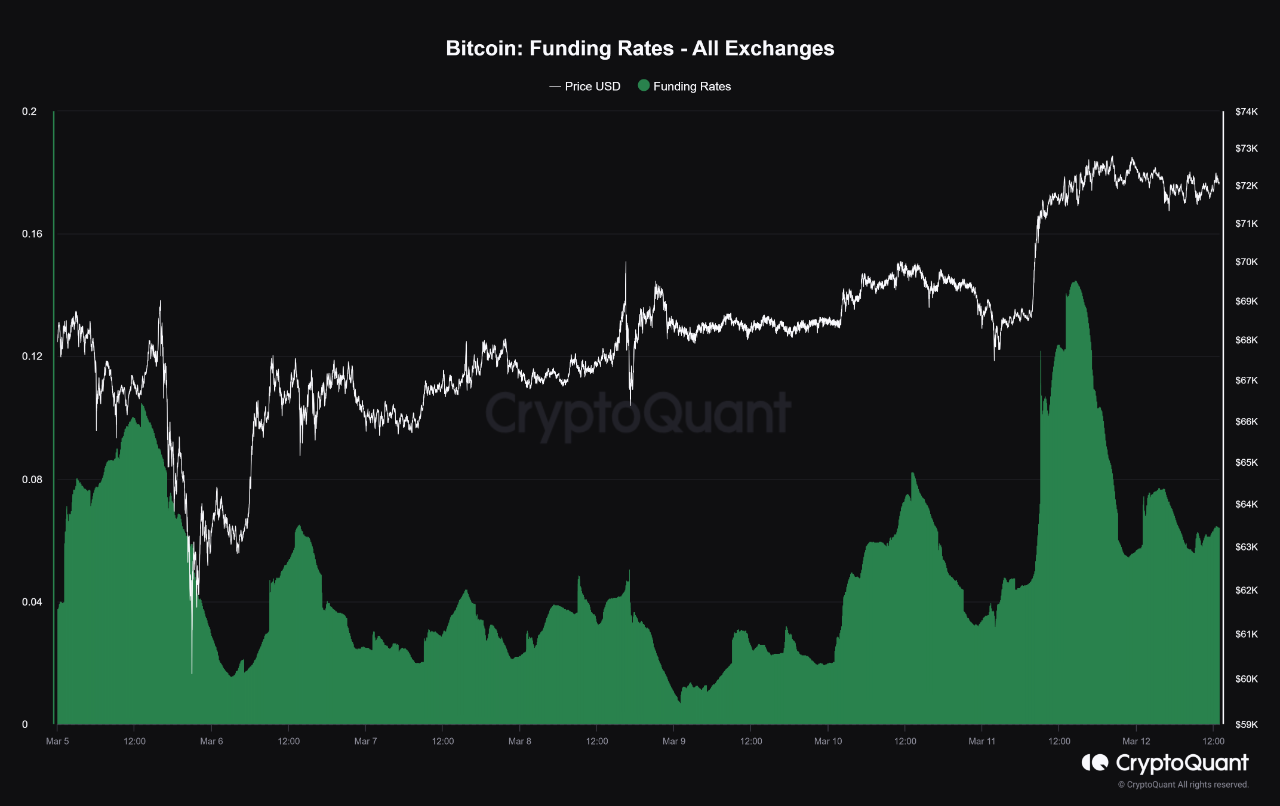
3/12/2024 Yesterday, traders paid as much as 150% annually to maintain long positions in Bitcoin perpetual futures due to the so-called funding rate. This has now dropped to 70%, which is, however, still remarkably expensive.
There is only one explanation for this: the appetite for leverage is through the roof. It is often not a good sign when every single trader agrees that the market is going higher and uses leverage to back their conviction.

View original →Ethereum has outperformed Bitcoin year-to-date.
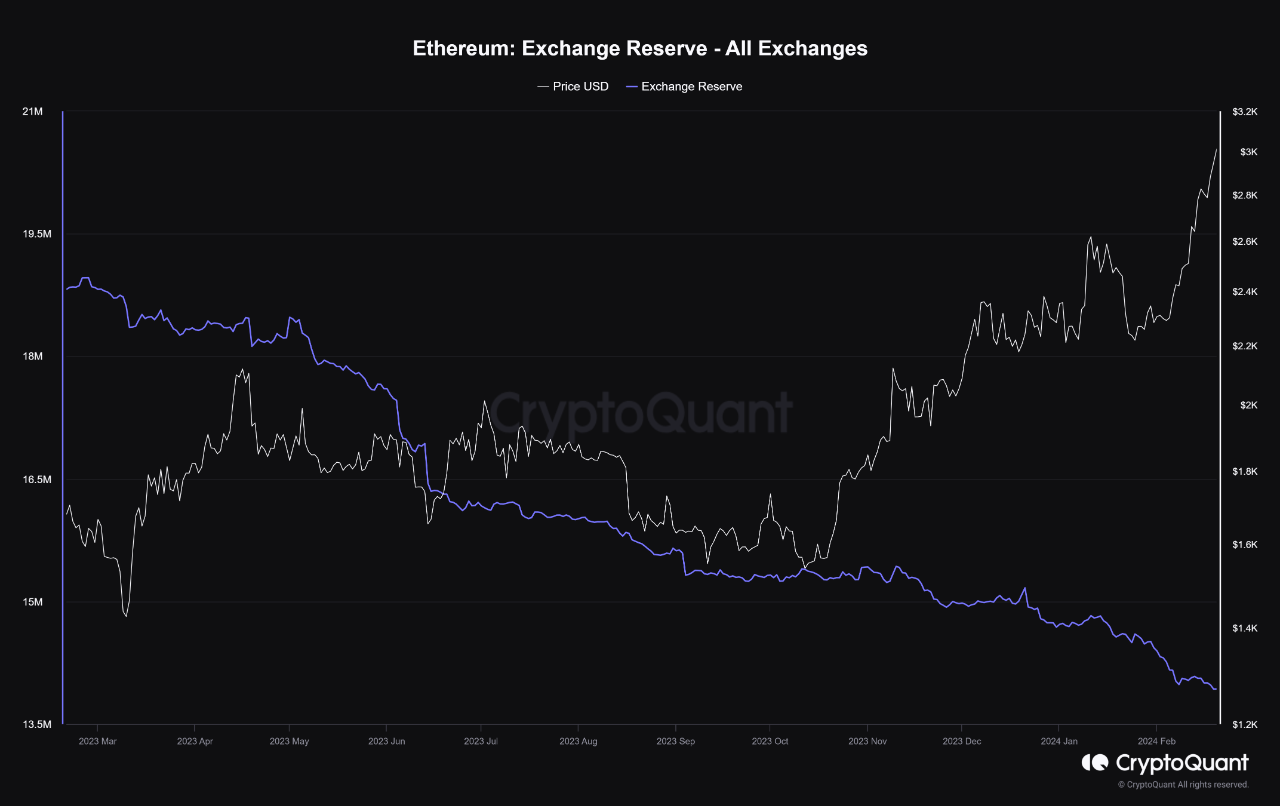
During the same period, exchanges have seen a net outflow of over 800,000 Ether, worth about $2.4 billion. It cannot be stated enough that this reduction in the Ether exchange reserve balance is extremely remarkable and, not least, bullish for Ethereum.

View original →The Bitcoin spot ETFs witnessed exceptionally high net inflows, totaling $405 million on Thursday and $541 million on Friday. Within just two days, these ETFs attracted almost $1 billion in Bitcoin net investments, a noteworthy achievement.
This surge in net inflows has resulted in the Coinbase Premium Index shifting to a premium almost matching its peak at the start of the year.

View original →There are few things as volatile as cryptocurrency prices.
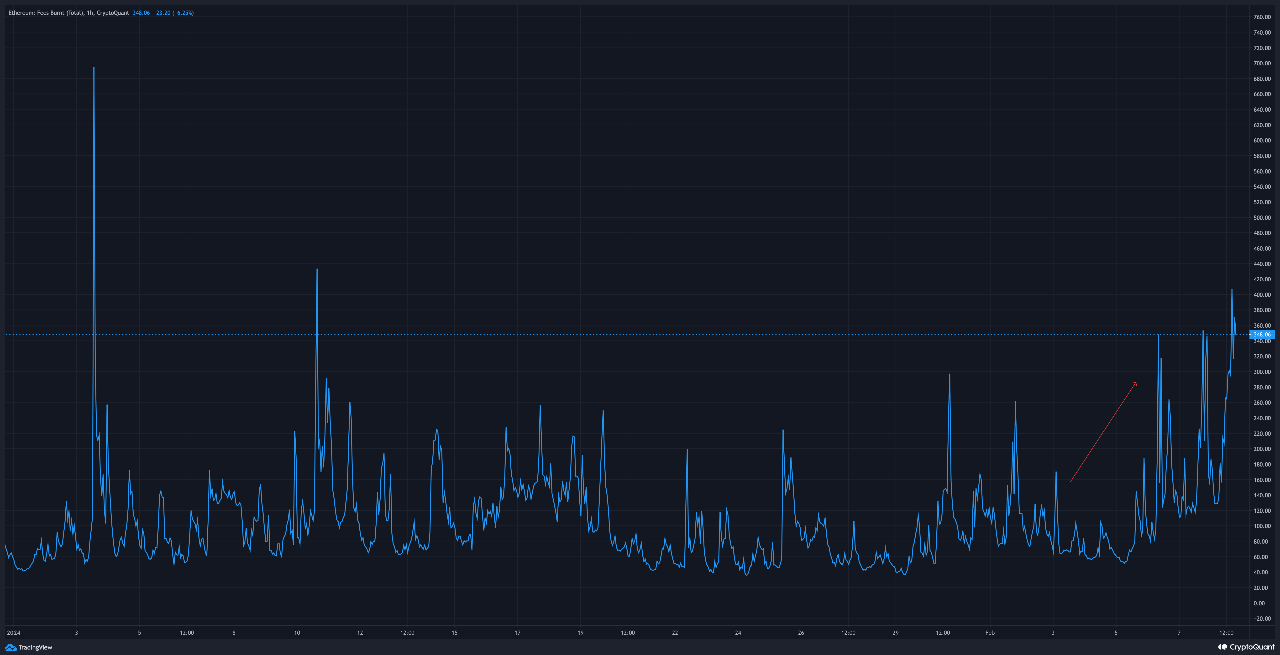
One notable exception may be Ethereum's total transaction fees. Recently, Ethereum's transaction fees have significantly increased, leading to the network burning more Ether from fees than it issues to stakers. In the past 24 hours, Ethereum has seen its supply decrease by about 3,200 Ether.
Not only do higher transaction fees reduce the supply, but they also reinforce Ethereum's 'ultrasound money' narrative.
In traditional markets, it is commonly believed that narrative follows price. However, in the crypto market, the opposite is mostly true: price follows narrative. This narrative is arguably even more critical for Ethereum than the direct price impact by the reduced supply.

View original →Bullish(Nuanced)BTCETH
2/7/2024 While I concur with Jamie Dimon's view that Bitcoin resembles a pet rock, it's important to acknowledge its merits when appropriate.
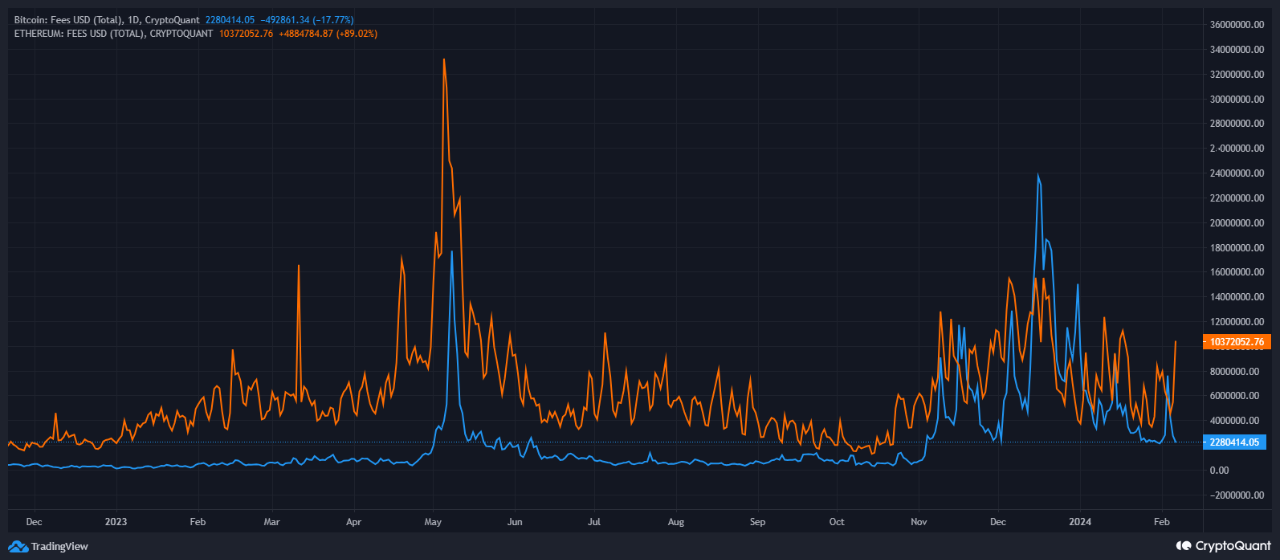
This chart is arguably the most impressive in the entire industry.
Historically, Ethereum has outpaced Bitcoin in generating transaction fees, similar to revenue, owing to its expansive ecosystem, particularly its decentralized applications.
Nevertheless, in recent months, Bitcoin's transaction fees have surged significantly, primarily because of the introduction of Ordinals. This surge has enabled Bitcoin to surpass Ethereum in terms of transaction fees on certain days, most recently on February 3rd.
This achievement is noteworthy, indicating that Bitcoin still harbors potential vitality, albeit somewhat discreetly.

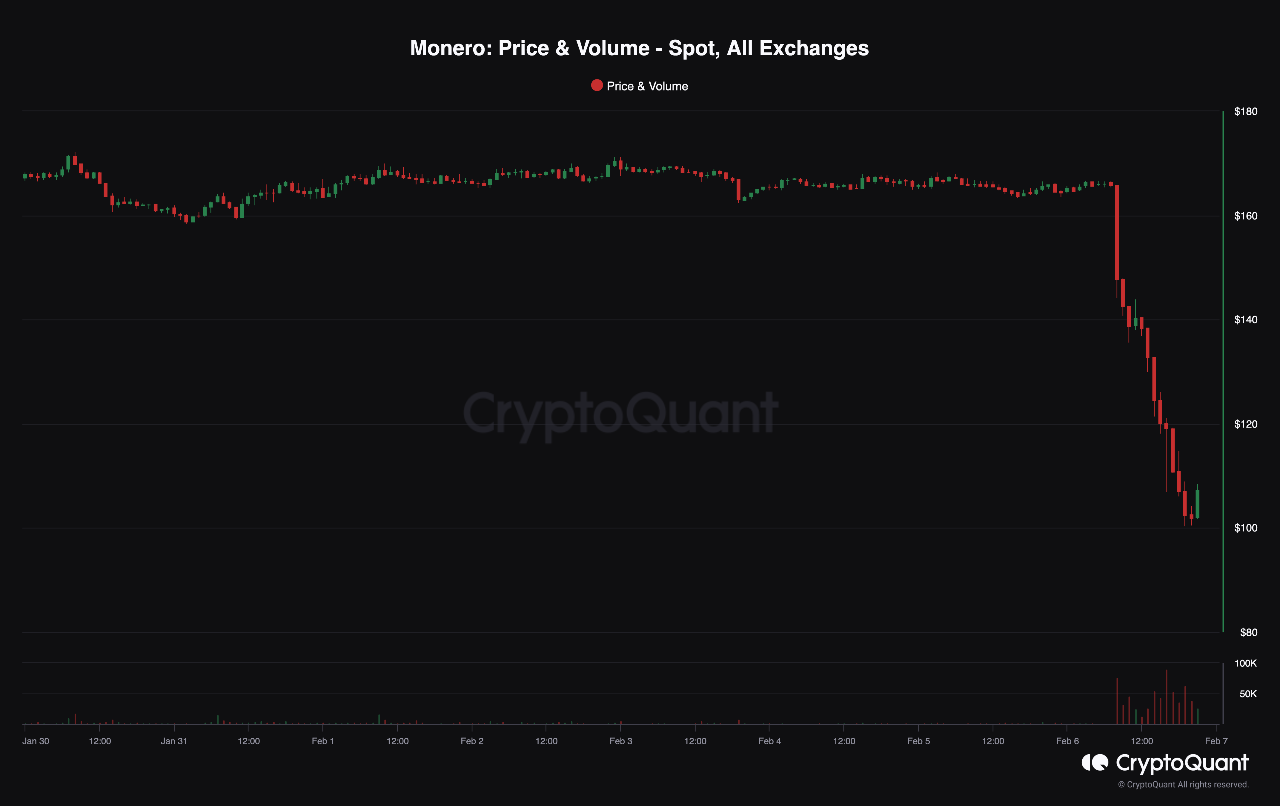
View original →The world's largest crypto exchange, Binance, delisted Monero earlier today, sending the cryptocurrency tumbling by over 30%.
Please exercise caution and avoid attempting to purchase Monero at this time, despite it looking "cheap" relative to yesterday. Attempting to do so is akin to catching a falling knife.
At Steno Research, we prioritize liquidity and adoption when assessing a cryptocurrency. These two critical factors are challenging to maintain without being listed on the world's largest cryptocurrency exchange. In our view, the delisting from Binance serves as a deathblow to Monero.

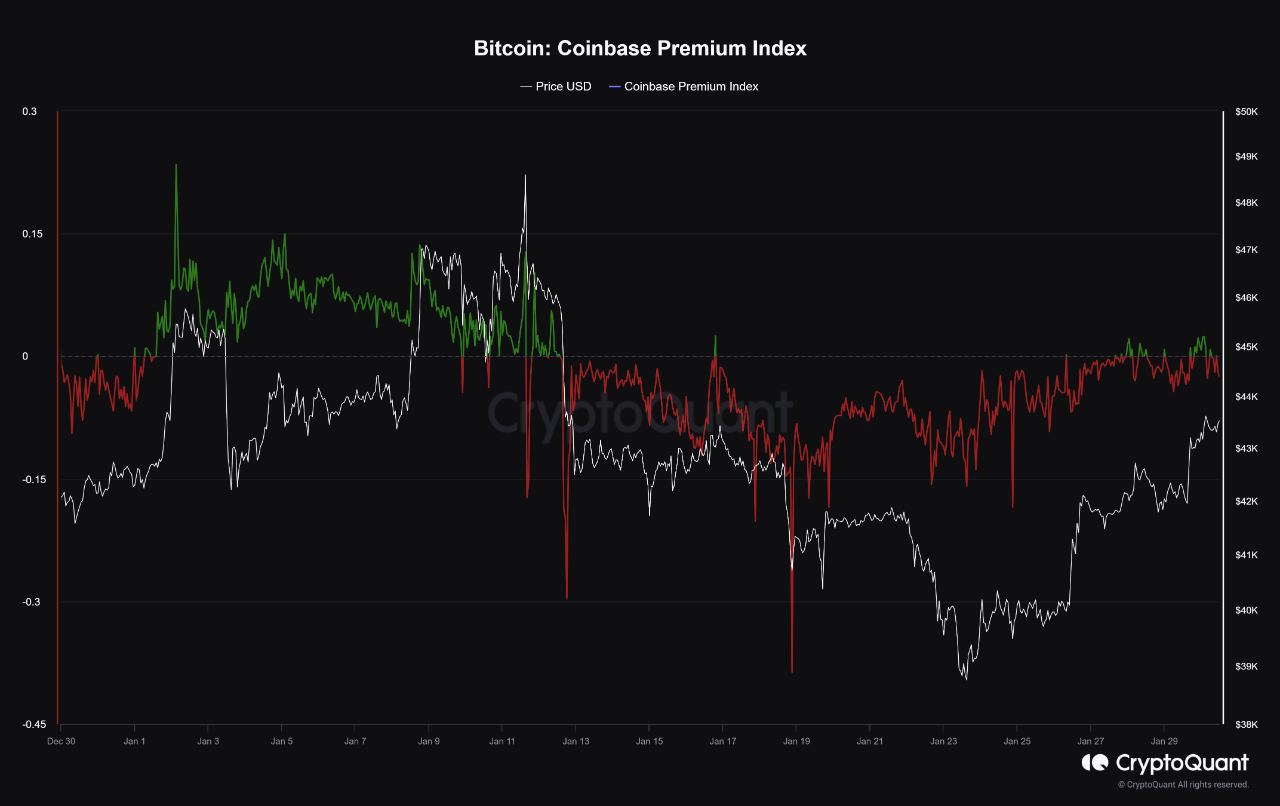
View original →Grayscale experienced an outflow of only $191 million yesterday. At the same time, and perhaps even more positively, BlackRock's iShares and Fidelity each recorded an inflow of around $200 million yesterday. In total, the ETFs' net inflow yesterday was $255 million.
Additionally, the Coinbase Premium Index, which has largely flipped back to showing a premium after nearly two weeks at a discount, indicates that a new status quo is indeed about to be established where ETF inflow exceeds outflow.


View original →Ethereum is a scarce asset.
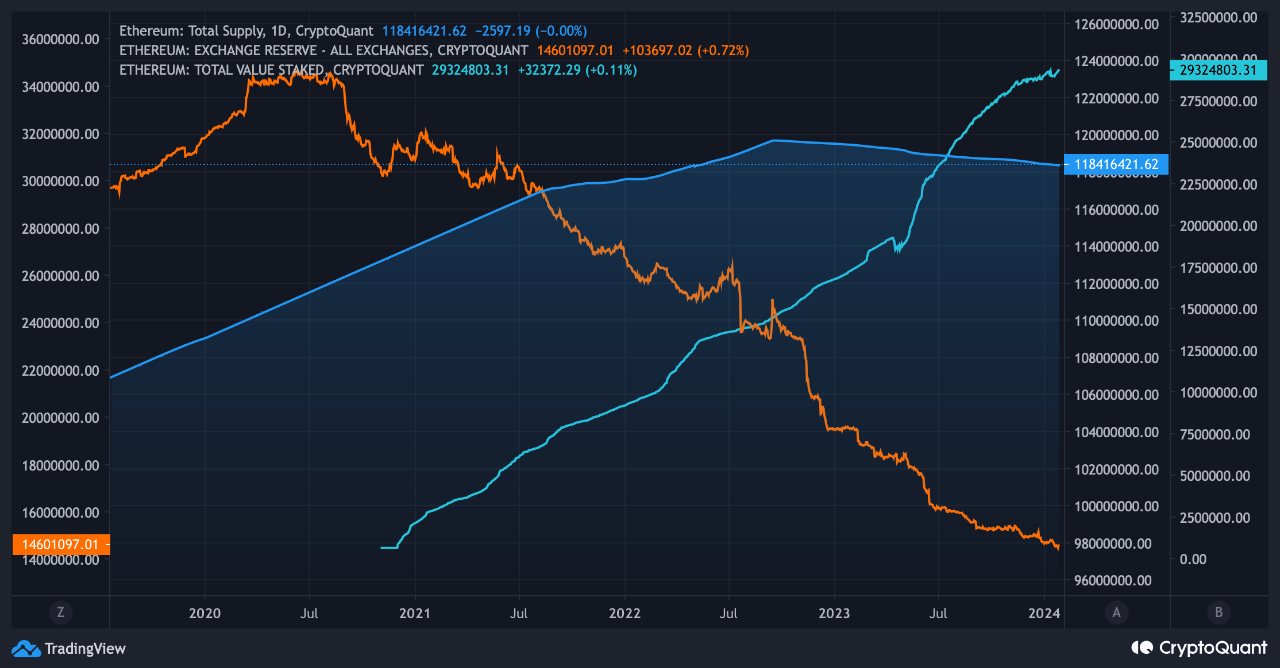
The second-largest cryptocurrency has turned deflationary upon the Ethereum merge on the 15th of September 2022, as more Ether is burned through transaction fees than what is issued to Ethereum stakers. This is fairly groundbreaking in the crypto world, as almost all other cryptocurrencies, including Bitcoin, tend to dilute their holders through inflation, often favoring miners over stakers. Since the merge, the total supply of Ethereum has decreased by slightly more than 340,000 Ether, notably, this decrease has occurred even during a period when the broader crypto market has been in a bear market.
At the same time, over 29 million Ether are staked, and a further 15 million is locked in various decentralized protocols, representing a significant portion of the total circulating supply of 120.2 million Ether. While these assets can be unlocked, some immediately and others in the foreseeable future, the majority of these holders, especially stakers, are likely to be long-term holders.
The balance of Ethereum in exchange reserves continues to decline. It has reached its lowest point since mid-2018, partly due to an increasing amount of Ether being locked in protocols, staked, and utilized for transaction fees. This suggests a decreasing likelihood of Ether being sold.
It is only a matter of time before the market recognizes the scarcity of Ethereum on par with that of Bitcoin, with Bitcoin expected to take center stage in April, during which the fourth Bitcoin halving is estimated to occur.

View original →

